Enabling Seamless Rural Connectivity: End-to-End Support Services for BharatNet Phase 3
The ambitious rollout of BharatNet Phase 3 marks a transformative step toward strengthening India’s rural digital backbone. With a renewed focus on high-speed, reliable broadband connectivity across Gram Panchayats, this phase demands precision-driven execution, stringent quality standards, and complete lifecycle documentation.
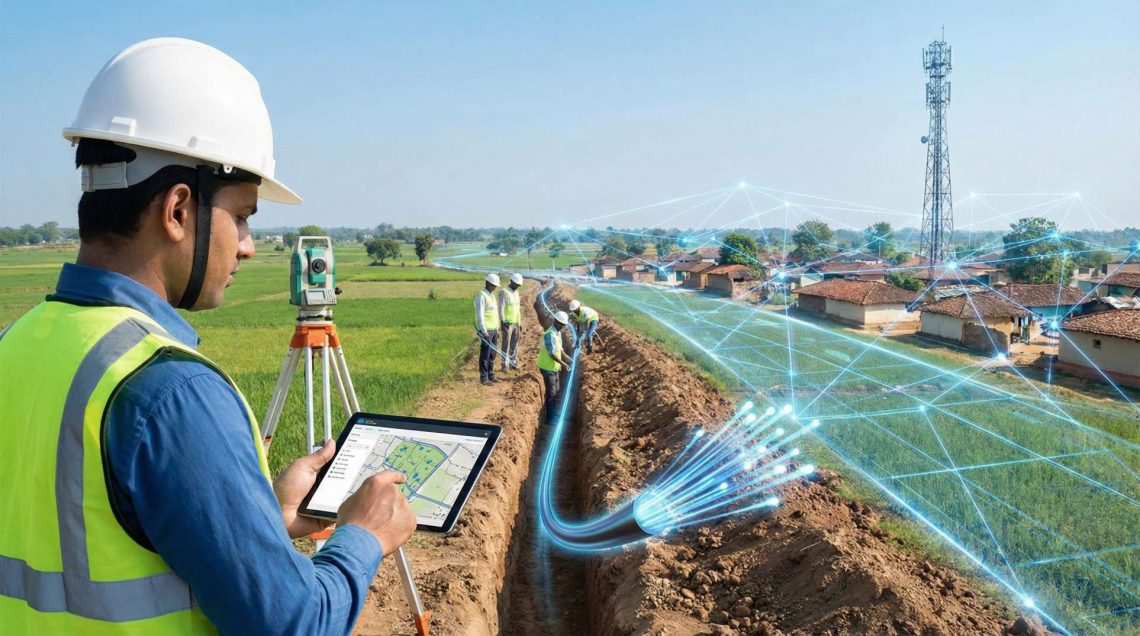
To ensure successful implementation, a comprehensive suite of GIS services plays a critical role — from route planning surveys to HOTO documentation and identification of damage section of existing network through advanced fiber testing. Below is an overview of the key GIS services essential for BharatNet Phase 3 deployment.
1. GIS Route Survey & Network Planning:
Accurate route planning forms the foundation of a robust fiber network.
Scope of Services:
- Detailed GIS-based route mapping using DGPS instruments.
- Using of CORS (Continuously Operating Reference Stations) enabled GNSS devices to get apprx. 5 cm accuracy.
- Alignment finalization along roads, railways, and utility corridors
- Existing/Brownfield asset mapping (Gram Panchayat (GP) infrastructure, manholes, OFC joints, OLT locations, power connectivity, solar panel etc.)
- AutoCAD/KMZ file preparation
- Route index diagrams and as-built drawing generation
GIS surveys ensure optimal routing, reduced right-of-way conflicts, and precise asset documentation for long-term maintenance.
2. 360-Degree Videography & Route Documentation
For transparency, monitoring, and future audits, 360-degree videography has become a crucial requirement.
Key Deliverables:
- Geo-tagged 360° video capture of the entire fiber route
- Pre-laying and post-laying documentation
- HD visual evidence of trenching, duct laying, and reinstatement
- Integration with GIS platforms
This enables stakeholders to virtually inspect route conditions and maintain digital records of field execution.
3. HOTO & Optical Fiber Testing Services (OTDR & LSPM)
Deployment of FRT team to existing fiber network section for identifying and validating damage part through rigorous optical testing.
OTDR Testing (Optical Time Domain Reflectometer)
- End-to-end fiber characterization
- Splice loss measurement
- Fault detection and distance calculation
- Event table and trace report generation
LSPM Testing (Light Source & Power Meter)
- Optical power loss measurement
- Link attenuation validation
- Compliance testing as per BharatNet standards
These tests ensure identification of damage section, minimum signal loss and compliance with defined performance benchmarks.
4. BOQ/SOQ Preparation & Finalization
Accurate financial planning and execution tracking require structured BOQ/SOQ documentation.
Key Deliverables:
- Preparation of BOQ/SOQ based on Brownfield and Greenfield Survey
- Finalization of item and quantity based on new network laying scope and damage section reconstruction scope.
- Test reports (OTDR & LSPM)
- Material reconciliation (duct, OFC, joint closures, hardware)
- Route index and chainage details
- Alignment with tender specifications
- Assistance in finalization with implementing agencies
- BOQ/SOQ approval from Independent Engineer (IE) / BSNL.
This minimizes discrepancies and supports transparent project billing.
5. ABD (As-Built Documentation) & L14 Diagram
ABD is the backbone of project closure and future maintenance.
Comprehensive ABD, L-14 Diagram Includes:
- Final as-built route drawings
- Fiber core allocation details
- Jointing diagrams
- OLT to ONT connectivity layout
- Fiber core allocation mapping
- Distribution hierarchy representation
- Splice connectivity schematic
- Integration with GP and block-level infrastructure
- GIS database submission
Proper ABD, L14 diagram ensures smooth asset handover and long-term operational efficiency.
Conclusion:
The success of BharatNet Phase 3 depends not only on laying optical fiber but on executing the project with technical precision, compliance discipline, and digital documentation excellence.
From GIS route surveys and 360-degree videography to OTDR testing, splicing, BOQ finalization, ABD compilation, L14 diagram preparation, and structured HOTO support — a comprehensive, end-to-end service framework ensures that rural India’s digital highway is built to global standards.
Reliable connectivity begins with reliable execution.


You May Also Like