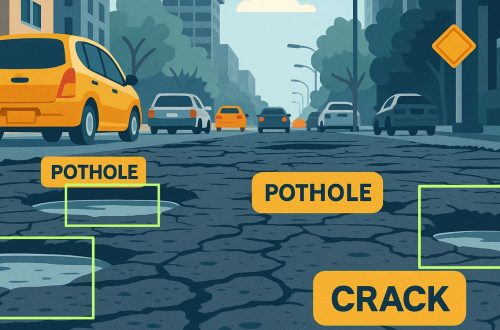
AI Based Road Condition Monitoring System: Transforming Infrastructure Management
Road infrastructure is a vital component of urban and rural connectivity. However, maintaining roads in good condition is a constant challenge due to factors such as weather, traffic load, and natural wear and tear. Traditional road inspection methods are often time-consuming, labour-intensive, and prone to human error. An AI-based Road Condition Monitoring System leverages artificial intelligence, computer vision, and geospatial technologies to automate road inspections, enhance maintenance efficiency, and improve transportation safety.
Objectives of AI-Based Road Condition Monitoring
- Automated Road Inspection: Reduce manual efforts by using AI and machine learning to detect road defects.
- Real-Time Condition Assessment: Provide up-to-date information on road quality.
- Efficient Maintenance Planning: Prioritize road repairs based on severity and location.
- Cost Optimization: Reduce operational costs associated with traditional inspections.
- Enhanced Road Safety: Identify hazardous road conditions to prevent accidents.
Key Components of the System
1. Data Collection via Mobile Application
- Mobile mounted on vehicles or drones to capture road videos.
- Mobile GPS integration for precise geolocation of road defects.
2. GIS-Based Mapping & Data Visualization
- Integration with Geographic Information Systems (GIS) for spatial analysis.
- Dashboards for road condition monitoring.
3. Road Condition Measurement using PCI
- Road condition measured using standard pavement condition index
- Reporting based on PCI
4. Predictive Maintenance & Decision Support
- AI-driven insights to forecast potential road failures.
- Priority ranking of maintenance tasks based on PCI.
- Integration with municipal road management systems for automated work order generation.
5. Automated Alerts & Reporting
- Instant notifications to municipal authorities and road maintenance teams.
- Regular reports and analytics to track improvements and budget allocations.
Implementation Approach
- Data Acquisition: Deploy mobiles with the data collection app on, municipal vehicles, Bikes and Rented cars.
- AI Model Training & Optimization: Develop and fine-tune deep learning models for accurate defect detection.
- System Integration: Connect the AI system with GIS platforms and municipal infrastructure databases.
- Pilot Testing & Calibration: Run pilot projects in selected areas to evaluate system accuracy and efficiency.
- Full-Scale Deployment & Continuous Monitoring: Implement city-wide or region-wide monitoring with periodic updates.
Benefits of AI-Based Road Condition Monitoring
- Faster Inspections: AI enables real-time analysis, reducing the need for manual surveys.
- Improved Accuracy: Machine learning minimizes human error in defect detection.
- Improved Budget Allocation: Data-driven insights help optimize road maintenance budgets.
- Enhanced Public Safety: Proactive maintenance reduces accident risks and improves driving conditions.
- Sustainable Urban Development: Supports smart city initiatives by integrating with other digital infrastructure solutions.
Future Prospects and Challenges
The integration of AI in road condition monitoring is expected to evolve with advancements in deep learning, edge computing, and autonomous inspection vehicles. However, challenges such as data privacy concerns, high initial investment, and the need for skilled workforce must be addressed. Collaboration between government bodies, technology providers, and urban planners will be key to the widespread adoption of this system.
Conclusion
An AI-based Road Condition Monitoring System revolutionizes traditional road maintenance by providing automated, real-time, and data-driven insights. By leveraging AI, computer vision, and GIS, this system ensures more efficient road inspections, optimized resource allocation, and enhanced road safety. As cities grow, adopting such technology-driven approaches will be crucial for sustainable and intelligent infrastructure management.

He is a business development professional with 10+ years of experience in Sales, Pre-Sales, Market Research, Concept Selling, Business Development, and Account Management. Skilled in managing end-to-end sales processes, including lead generation, pre-sales, account management, post-sales, and customer support. Holds an MCA degree.
Currently leading the Urban Development vertical at CyberSWIFT Infotech, with key responsibilities that include:
Managing business operations across India, Overseeing and mentoring teams to achieve targets, Identifying and exploring new application areas and growth opportunities.
Avik Bhattacharya
He is a business development professional with 10+ years of experience in Sales, Pre-Sales, Market Research, Concept Selling, Business Development, and Account Management. Skilled in managing end-to-end sales processes, including lead generation, pre-sales, account management, post-sales, and customer support. Holds an MCA degree. Currently leading the Urban Development vertical at CyberSWIFT Infotech, with key responsibilities that include: Managing business operations across India, Overseeing and mentoring teams to achieve targets, Identifying and exploring new application areas and growth opportunities.

You May Also Like
Road Condition Monitoring System(RCMS): Enhancing Efficiency with AI-Powered Solutions
Challenges in Monitoring Road Infrastructure and GIS-Based Solutions